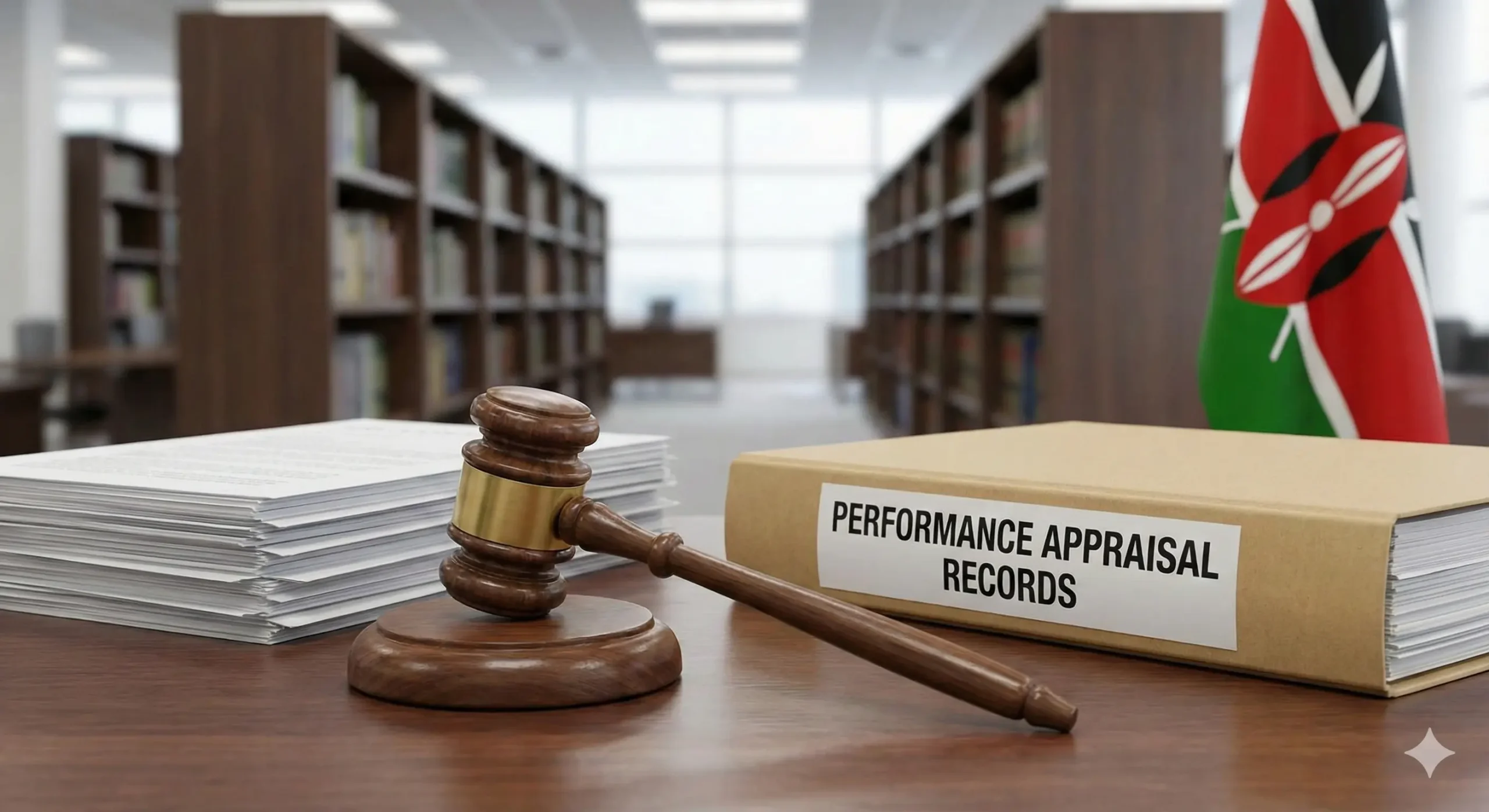
Why You Must Carry Out Performance Appraisals for Employees
The Single Missing Document That Is Costing Kenyan Employers Millions
By William Karoki Advocates (WKA Advocates) – wakilihub.co.ke/
If you walk into the Employment and Labour Relations Court (ELRC) today to defend a termination for “Poor Performance,” the Judge will ask for one thing before you even speak: The Performance Appraisal Records.
If you cannot produce them—signed, dated, and historically consistent—you have already lost the case.
In 2025, the ELRC has established a rigorous standard: You cannot dismiss an employee for poor performance unless you can prove you gave them a structured, documented opportunity to improve. The days of “firing for incompetence” based on a manager’s subjective opinion are over.
Recent judgments, such as [suspicious link removed] and the recent Umba Fintech Ruling, confirm that failing to conduct lawful appraisals is now classified as Unfair Termination, attracting penalties of up to 12 months’ gross salary plus damages.
This comprehensive guide explains the new legal standard for performance management and how WKA Advocates helps you build a defense-ready appraisal system.
1. The “Vincent Namai” Precedent: A KSh 5 Million Warning
Case Study: Vincent Namai v National Bank of Kenya Limited (2023)
This ruling shook the Kenyan HR industry. Mr. Namai, a branch manager, was terminated for poor performance after failing to meet his targets. The bank had put him on a Performance Improvement Plan (PIP). On paper, it looked like a textbook dismissal.
Why the Employer Lost (and paid KSh 5 Million): The court found that while the employee did underperform, the employer had failed to consider his grievances. Mr. Namai argued that his poor performance was due to a lack of support, abrupt transfers, and a difficult operating environment (COVID-19).
The Verdict: The Judge ruled that an appraisal process is unfair if it is a “one-way street.” Because the employer did not genuinely address the external factors affecting his work or provide the necessary tools to succeed, the termination was unlawful.
Read the Case Analysis: Business Daily: Risks for employers sacking ‘poor performers’
The Lesson: A performance appraisal is not just about scoring the employee; it is about documenting the support you provided to help them succeed. If you cannot prove you offered training or resources, the Court will view the failure as yours, not theirs.
2. The Law: Section 41 & The “Fair Reason” Rule
Under Section 41 of the Employment Act, 2007, “Poor Performance” is a valid ground for termination. However, the burden of proof lies 100% with the employer.
To prove poor performance in 2025, you must satisfy the “Substantive Fairness” Test. You must produce evidence of:
-
Clear Standards: Did the employee know exactly what was expected (Signed KPIs/Targets)?
-
Regular Feedback: Did you tell them they were failing before the final crisis?
-
Opportunity to Improve: Did you place them on a structured PIP?
-
No External Blockers: Did you ensure their failure wasn’t caused by a lack of tools, budget, or managerial negligence?
Warning: A termination letter that simply states “Your performance has been unsatisfactory” is legally worthless without the appraisal forms to back it up.
3. The 3-Step Lawful Appraisal Process
To protect your business, your appraisal system must follow this WKA-approved cycle.

Step 1: Goal Setting (The “Contract of Expectations”)
At the start of the year (or employment), you must sit with the employee and agree on SMART goals (Specific, Measurable, Achievable, Relevant, Time-bound).
-
Legal Tip: Both parties must sign this document. If an employee refuses to sign, you must document the refusal in the presence of a witness.
Step 2: The Mid-Year Review (The “Early Warning”)
You cannot wait until December to tell someone they failed in January. The ELRC expects “intermittent reviews.”
-
If performance is dipping, issue a “Note of Concern”—this is a soft warning that predates a disciplinary letter. It serves as proof that the employee was aware of their shortcomings early on.
Step 3: The Performance Improvement Plan (PIP)
If the employee is consistently failing, you must place them on a PIP.
-
Duration: Recent case law suggests a PIP should run for at least 30 to 90 days. A 1-week PIP is viewed as a “sham” designed to justify a predetermined dismissal.
-
Content: The PIP must list the specific gap, the required standard, the support the manager will provide (training/coaching), and the review dates.
4. Probation is No Longer a “Free Pass”
Case Study: The Umba Ruling (2025)
Many employers believe they can fire probationary employees without process. In 2025, the court ruled against fintech company Umba for terminating a Head of Growth during probation via a WhatsApp call.
The Verdict: The court held that Section 41 applies even to probation. An employee on probation is entitled to:
-
Clear reasons for termination.
-
A fair hearing.
-
A chance to defend themselves.
The Cost: The company was ordered to pay KSh 2.88 million because they could not produce a performance evaluation record for the probationary period.
See Report: TechCabal: Court Orders Umba to Pay Damages
5. Strategic Employment Law: Partnering with WKA Advocates
In today’s litigious business environment, the cost of a single procedural error can be devastating. Kenyan courts have made it clear: the burden of proof lies entirely with the employer. WKA Advocates moves beyond reactive legal defense to become your proactive strategic partner.
The “Pre-Termination” Compliance Shield We operate a specialized “Pre-Termination Audit.” Before your HR department issues a final dismissal letter or a Notice to Show Cause, our legal team conducts a forensic review of the entire evidentiary trail. We examine your investigation reports and disciplinary minutes to ensure they meet the rigorous specificity standards set by the Akala v KCB ruling. This intervention allows you to proceed with a termination only when your legal footing is absolute.
Neutralizing Bias with Independent Chairpersons We eliminate the risk of bias allegations by providing our Independent Chairperson Service. We deploy seasoned legal professionals to preside over your internal disciplinary and capability hearings. This protects your leadership team from emotional conflict and ensures a high-quality, legally reasoned verdict that is far more likely to be upheld by the Court.
The Strategic Alternative: Mutual Separation Agreements For sensitive exits involving senior executives, we specialize in negotiating Mutual Separation Agreements. We facilitate dignified, confidential exits that bypass the acrimony of dismissal, providing your organization with the ultimate legal certainty: a clean break with zero risk of future litigation.
Conclusion: Documentation is Your Only Defense
In a “Poor Performance” case, the employee will say, “My boss hated me.” You must be able to say, “Here are the signed minutes of 4 review meetings where we offered training that was refused.”
Without appraisals, you are not managing performance; you are preparing for a lawsuit.
Is your Appraisal System legally compliant?
For expert support with Disciplinary Hearings, PIPs, and Employment Contracts, contact us today.
William Karoki Advocates (WKA Advocates)
Your Strategic Legal Partner in Employment Law
-
Phone: +254 798 035 580
-
Email: info@wka.co.ke
-
Website: wakilihub.co.ke/
-
Visit Us: Valley View Business Park, 6th Floor, Suite 35, City Park Drive, Parklands, Nairobi.