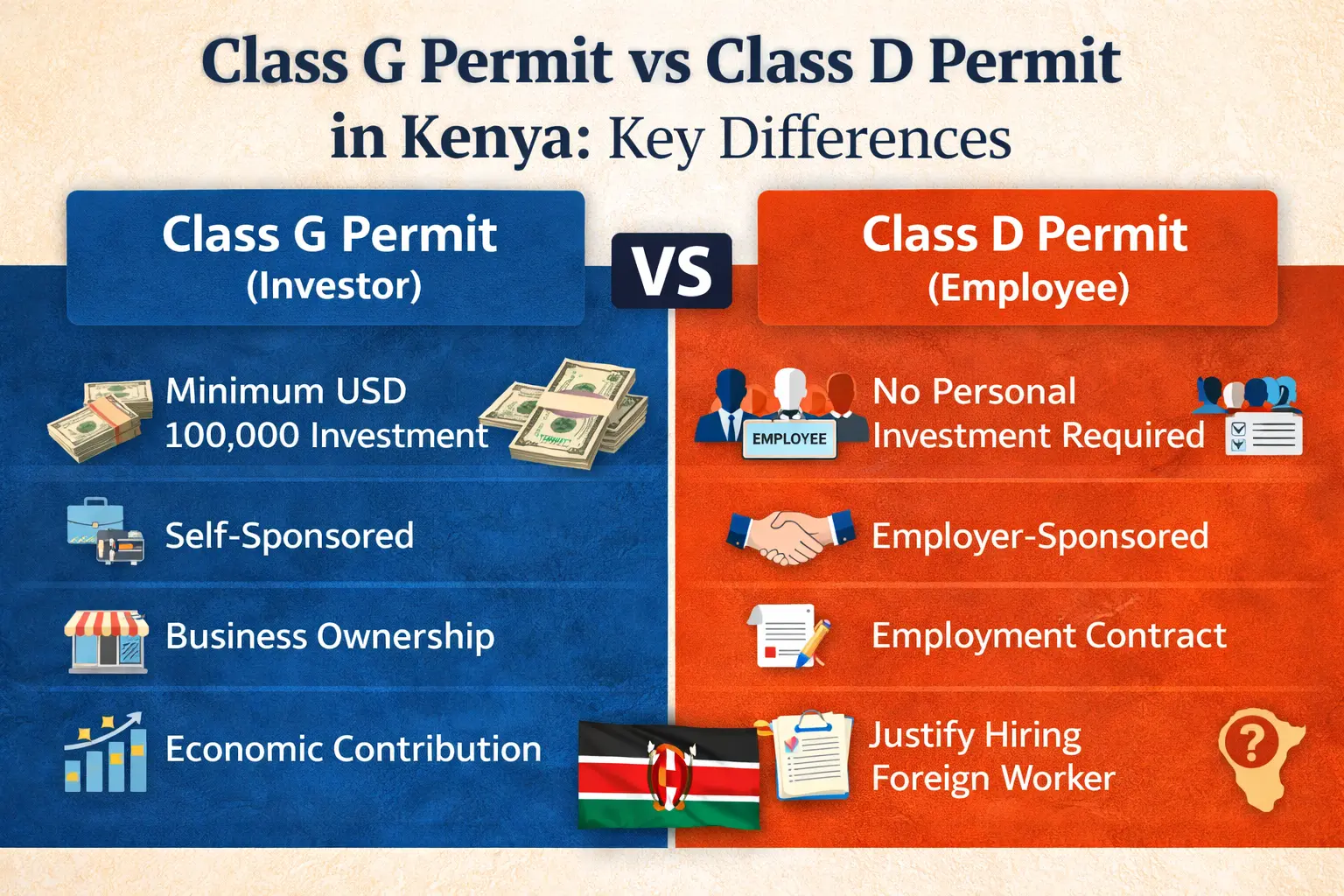
Class G Permit vs Class D Permit in Kenya: Key Differences (2026 Legal Guide)
A Comprehensive Legal Comparison by WKA Advocates
Foreign nationals who intend to work, invest, or operate businesses in Kenya must obtain the correct immigration authorization. Two of the most commonly misunderstood permits are the Class G Permit (Investor Permit) and the Class D Permit (Employment Permit).
Understanding the Class G Permit vs Class D Permit in Kenya is essential for ensuring immigration compliance, successful work permit applications, and long-term business planning.
In this guide, WKA Advocates explains the legal framework, eligibility criteria, capital requirements, sponsorship obligations, and strategic considerations that distinguish these two permits.
Legal Framework for Work Permits in Kenya
Both Class G and Class D permits are issued under the Kenya Citizenship and Immigration Act and administered by the Directorate of Immigration Services.
Although both permits authorize foreign nationals to work in Kenya, they apply to different immigration categories based on whether the applicant is an investor or an employee.
What Is a Class G Permit in Kenya?
The Class G Permit, commonly known as the Investor Permit, is issued to foreign nationals who wish to establish, invest in, or manage a business in Kenya.
This permit applies to individuals who:
- Establish new businesses in Kenya
- Invest in existing Kenyan companies
- Operate as sole proprietors
- Provide consultancy services independently
- Actively manage businesses they own or co-own
Minimum Investment Requirement
To qualify for a Class G Permit in Kenya, applicants must demonstrate a minimum capital investment of USD 100,000 in a Kenyan enterprise.
The permit links the foreign national directly to the approved business activity and investment structure.
What Is a Class D Permit in Kenya?
The Class D Permit is issued to foreign nationals who have been offered employment by a Kenyan company.
This permit typically applies to:
- Skilled expatriate employees
- Technical experts
- Senior managers and executives
- Professionals hired for specialized roles
Key Requirement: Employer Sponsorship
Applicants must have:
- A valid employment contract with a Kenyan company
- A Kenyan employer acting as sponsor
- Evidence that the position cannot be filled by a qualified Kenyan citizen
Unlike the Class G Permit, the Class D Permit does not require personal capital investment.
Class G Permit vs Class D Permit in Kenya: Key Differences
Understanding the differences between these permits helps foreign nationals select the correct immigration category.
1. Nature of Engagement
Class G Permit
- Designed for investors and entrepreneurs
- Self-sponsored
- Linked to business ownership or partnership
Class D Permit
- Designed for foreign employees
- Employer-sponsored
- Linked to a specific employment contract
2. Capital Investment Requirement
Class G Permit
- Minimum USD 100,000 capital investment
Class D Permit
- No personal investment required
This is one of the most important distinctions when evaluating Class G Permit vs Class D Permit in Kenya.
3. Sponsorship Structure
Class G Permit
- The investor’s own company supports the application
Class D Permit
- A Kenyan employer sponsors the permit
Employer compliance obligations play a major role in Class D permit applications.
4. Economic Contribution Requirements
Class G Permit
Applicants must demonstrate:
- Business viability
- Economic contribution
- Potential job creation
- A detailed business plan
Class D Permit
Employers must demonstrate:
- Justification for hiring a foreign national
- Evidence of a skills gap
- Training or understudy plans for Kenyan employees
5. Risk Exposure
Class G Permit
- Renewal depends on business performance
- Requires tax compliance and operational activity
Class D Permit
- Immigration status depends on continued employment
- Permit becomes invalid if the employment contract ends
6. Renewal Requirements
Class G Permit Renewal
Investors must demonstrate:
- Continued capital investment
- Active business operations
- Compliance with Kenya Revenue Authority tax obligations
Class D Permit Renewal
Applicants must provide:
- Updated employment contract
- Employer compliance documentation
- Continued employment confirmation
7. Suitability
Class G Permit is best for:
- Entrepreneurs
- Foreign investors
- Business founders
- Independent consultants
Class D Permit is best for:
- Skilled expatriate employees
- Technical specialists
- Senior managers hired by Kenyan companies
Strategic Considerations When Choosing Between Class G and Class D
Applying for the wrong permit category may lead to:
- Application rejection
- Immigration delays
- Compliance violations
- Business disruptions
At WKA Advocates, we conduct comprehensive eligibility assessments to determine the most appropriate permit.
Key factors considered include:
- Shareholding structure
- Employment relationships
- Business ownership percentage
- Capital investment levels
- Long-term residency plans
- Tax exposure
Documentation Requirements
Class G Permit Documents
Applicants typically submit:
- Certificate of incorporation
- CR12 company records
- Proof of USD 100,000 investment
- Business plan
- Tax registration documents
Class D Permit Documents
Applicants usually provide:
- Employment contract
- Employer support letter
- Academic certificates
- Professional qualifications
- Justification for hiring a foreign national
Cost Comparison
Class G Permit Costs
- Minimum capital investment USD 100,000
- Government application fees
- Company registration expenses
- Licensing costs
Class D Permit Costs
- Government application and issuance fees
- Employer compliance expenses
- Immigration processing costs
Due to the investment requirement, Class G permits involve higher financial thresholds.
Common Mistakes Applicants Make
Foreign nationals often encounter issues due to:
- Applying for Class D while owning and managing a business
- Applying for Class G without meeting the capital threshold
- Improper shareholding structures
- Failure to maintain tax compliance
Professional legal advisory significantly improves application success.
Why Work with WKA Advocates?
Understanding Class G Permit vs Class D Permit in Kenya requires expertise in immigration law, corporate structuring, employment law, and tax regulation.
WKA Advocates provides:
- Work permit eligibility assessments
- Immigration application preparation
- Corporate structuring advisory
- Employment compliance guidance
- Permit renewal support
- Appeals and immigration representation
Our integrated legal approach ensures foreign nationals obtain the most suitable immigration permit for their business or employment objectives.
Frequently Asked Questions
Can a shareholder apply for a Class D Permit?
If the individual actively manages the business, the Class G Permit is usually more appropriate.
Can a Class D permit holder switch to Class G?
Yes, provided the applicant meets the USD 100,000 capital investment requirement and submits a new application.
Can either permit lead to permanent residence?
Long-term lawful residence and compliance may support future permanent residency applications, subject to Kenyan immigration eligibility requirements.
Conclusion
The main difference between Class G Permit vs Class D Permit in Kenya is investment versus employment.
- Class G Permit: Designed for investors and business owners who meet the capital investment requirement.
- Class D Permit: Designed for foreign employees sponsored by Kenyan employers.
Choosing the correct permit ensures legal compliance, operational stability, and long-term immigration security.
With expert legal guidance from WKA Advocates, foreign nationals can structure their immigration status effectively and pursue busine