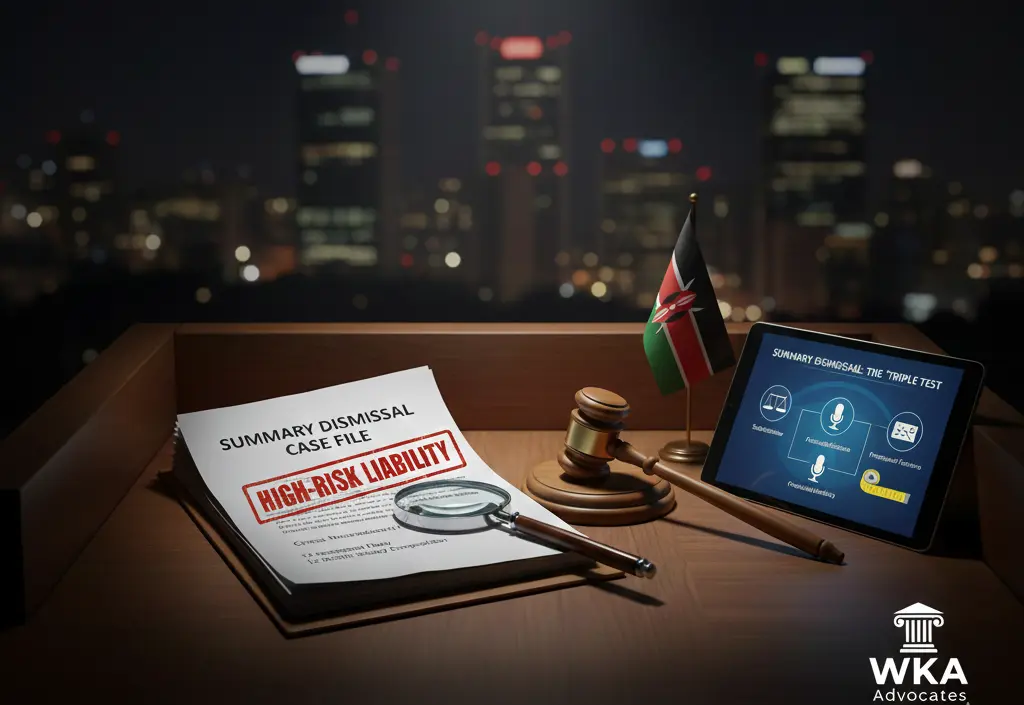
Carrying Out Summary Dismissal in Kenya
A comprehensive 2025 guide on lawful summary dismissal in Kenya. Learn legal procedure, gross misconduct rules, disciplinary steps, ELRC risks, and employer protections.
Summary dismissal in Kenya is often referred to as the nuclear option in employment law. It allows an employer to terminate an employee without notice or notice pay where the employee’s conduct is so serious that it destroys the trust inherent in the employment contract.
When executed properly and in strict compliance with the Employment Act, summary dismissal protects the employer from internal threats such as fraud, negligence, violence, or gross insubordination—while costing only accrued salary and unused leave.
However, even a minor procedural error exposes the employer to massive liability.
The Employment and Labour Relations Court (ELRC) regularly awards:
-
Up to 12 months’ gross salary in compensation
-
Interest of up to 14% from date of filing
-
Costs of the suit
-
Additional penalties for violating the Employment Act
In 2024–2025, ELRC awards against employers have reached historic highs due to poor procedural compliance.
At WKA Advocates, we have successfully defended numerous summary dismissal claims and equally helped senior executives obtain damages where employers failed to follow due process. This authoritative guide shows employers exactly how to execute a lawful summary dismissal in Kenya, avoid litigation, and strengthen internal HR compliance.
Understanding Gross Misconduct Under Kenyan Labour Law
Section 44(4) of the Employment Act, 2007 (link below) outlines the statutory grounds for summary dismissal:
🔗 Employment Act (Kenya) – Section 44
However, Kenyan case law from 2023–2025 has significantly expanded what qualifies as gross misconduct. Today, valid grounds for summary dismissal include:
✔ Theft, attempted theft, or fraud — irrespective of the amount
Even misappropriating petty cash or falsifying a receipt.
✔ Physical violence or credible threats
Including threats on WhatsApp or internal communication tools.
✔ Gross insubordination
Such as refusal to follow lawful instructions, abusive language, or rebellion against supervision.
✔ Gross negligence resulting in loss
E.g., failing to secure company assets, mishandling sensitive client data.
✔ Breach of confidentiality or data protection laws
Especially under the Data Protection Act, 2019
🔗 https://www.odpc.go.ke/data-protection-act/
✔ Sexual harassment or inappropriate conduct
✔ Single acts of dishonesty
The Court of Appeal has ruled that even one dishonest act can terminate the trust at the heart of an employment contract.
Important:
The burden of proof lies with the employer—not the employee.
You must prove both:
-
That the act occurred, and
-
That it was serious enough to justify immediate termination.
The Mandatory Three-Part Test for Lawful Summary Dismissal
To survive ELRC scrutiny, a summary dismissal must satisfy the Three Legal Tests under Section 45 of the Employment Act and appellate court decisions:
1. Substantive Justification (Valid Reason)
The reason must be:
-
factually correct
-
supported by verifiable evidence
-
serious enough to justify immediate termination
-
connected to the employee’s misconduct
Suspicion or hearsay is NOT sufficient.
2. Procedural Fairness (Due Process)
Even if guilt appears obvious, procedural fairness is mandatory under Section 41 of the Act:
🔗 Employment Act – Section 41 (Right to be heard)
https://kenyalaw.org/caselaw/cases/view/135652/
Failure to follow procedure automatically makes dismissal unfair, regardless of the misconduct.
3. Proportionality (Fair Punishment)
The ELRC assesses whether summary dismissal was appropriate or whether:
-
a warning,
-
a suspension,
-
or redeployment
would have been more reasonable.
Fail any one part of this test, and the dismissal is ruled unfair termination.
The Correct Procedure for Summary Dismissal in Kenya (2025 Standard)
Firing someone on the spot is illegal—even with CCTV evidence. The law demands strict procedural steps.
Step 1: Immediate Suspension With Pay
Best practice requires:
-
full pay during suspension
-
suspension lasting no more than 14 days
-
an internal investigation during this period
Suspension protects evidence and prevents interference.
Step 2: Issue a Detailed “Show Cause” Letter
The letter MUST include:
-
specific allegations
-
dates, times, and evidence
-
references to violated policies or laws
-
request for a written explanation
-
clear timelines
This is a key document. Many employers lose cases because the allegations were vague or poorly drafted.
Step 3: Conduct a Proper Disciplinary Hearing
The employee must receive:
-
at least 48 hours to prepare
-
the right to representation (colleague or union rep)
-
clear notice of the hearing
Hearing Requirements
-
chaired by an impartial decision-maker
-
investigator and decision-maker must NOT be the same
-
minutes must be recorded
-
all parties allowed to speak
This step is where most employers fail.
Step 4: Make a Decision Based on Evidence, Not Emotion
The decision must reflect:
-
fairness
-
proportionality
-
consideration of mitigating factors
Step 5: Communicate the Decision in Writing
The letter must include:
-
reasons for dismissal
-
reference to evidence
-
date of termination
-
entitlement to appeal
Step 6: Settle All Statutory Dues Immediately
Even in summary dismissal, employers MUST pay:
-
salary up to the date of dismissal
-
overtime balance
-
allowances earned
-
accrued annual leave (converted to cash)
-
pension/NSSF remittances
Failure to pay on the termination date is itself a violation.
Evidence Requirements in 2025
Courts now demand:
-
CCTV footage with timestamps
-
digital evidence (emails, logs, WhatsApp messages)
-
forensic audit reports
-
witness statements
-
attendance logs
Poorly preserved evidence results in employer losses.
How WKA Advocates Protects Employers During Summary Dismissal
Employers face high risk. One misstep can result in multi-million-shilling liability.
WKA Advocates offers unmatched expertise in handling dismissals.
1. Drafting Legally Iron-Clad Documents
We prepare:
-
Show Cause letters
-
Suspension letters
-
Notice of Hearing letters
-
Dismissal or Warning letters
These documents must meet strict legal standards to survive ELRC challenges.
2. Chairing or Guiding Disciplinary Hearings
We can:
-
chair the hearing as an independent neutral
-
guide your HR team in real-time
-
ensure compliance with Sections 41, 43, and 45
This eliminates claims of bias and strengthens your defence.
3. Coordinating Forensic and Digital Evidence
We work with:
-
forensic auditors
-
digital investigation teams
-
CCTV technicians
-
cybersecurity experts
This ensures evidence is admissible under the Evidence Act.
4. Defence Litigation Before the ELRC
Should an employee sue, our firm provides:
-
aggressive defence
-
strategic litigation
-
settlement negotiation
-
appeals where necessary
Our track record involves dismissals of claims worth tens of millions.
Contact Us for Immediate Employer Support
William Karoki Advocates (WKA Advocates)
📞 24/7 Employer Support Line: +254 798 035 580
📧 Email: info@wka.co.ke
📍 Head Office: Valley View Business Park, 6th Floor, Suite 35, City Park Drive, Parklands, Nairobi
🌐 Website: https://wakilihub.co.ke/